
Your supply chain touches every order you ship and every euro of working capital on your balance sheet. When it runs well, nobody notices. When it doesn't, the symptoms show up everywhere: rising freight bills, stockouts next to overstock, warehouses bursting at the seams and customers asking where their order is. At Bull Consult, we fix the flow of goods end to end — and we quantify every improvement before we recommend it.
The challenge: costs are rising faster than your margins
Most supply chains were never designed. They grew — one supplier, one warehouse, one carrier agreement at a time — around a business that has since doubled, changed channels or gone international. What worked at last year's volumes quietly becomes this year's biggest cost problem.
Meanwhile the market moves against you from both sides. Freight rates, energy and labour costs keep climbing, while customers expect delivery that is faster, cheaper and more transparent than ever. Absorb the squeeze and your margin erodes; pass it on and your conversion rate does. The businesses we meet typically recognise several of these symptoms:
- Freight costs rising year after year, with agreements that were signed once and never renegotiated.
- Capital tied up in the wrong inventory — slow movers filling the shelves while bestsellers go out of stock.
- Stockouts and overstock existing side by side, because purchasing runs on gut feel instead of forecast-driven policies.
- A warehouse layout that grew organically, where pickers walk kilometres a day and every peak season hurts more than the last.
- No reliable view of the true cost per order — so nobody can say which products, channels or customers actually make money on delivery.
- Customers expecting next-day delivery and free returns, while your cost to serve creeps upward.
The good news: these are exactly the problems where structured supply chain work pays back fastest. Logistics costs typically make up five to fifteen percent of revenue, and in our experience a meaningful share of that spend can be recovered without cutting a single corner on service. None of this fixes itself, and headcount alone won't solve it — but every one of these problems responds to the same treatment: rigorous analysis, a clear strategy and disciplined, hands-on implementation. That is exactly what our consultants deliver.
What we offer: our logistics & supply chain services
Bull Consult works across the whole flow of goods — from supplier to customer doorstep. You can engage us for a targeted project, such as a freight tender or a warehouse redesign, or for a full end-to-end transformation. In every case, the same senior consultants who analyse your operation stay to implement the changes.
End-to-end supply chain optimisation
We map your entire flow of goods — suppliers, inbound freight, warehousing, production where relevant, outbound distribution and returns — and put a cost on every link. That map exposes the trade-offs that matter: where paying slightly more for transport saves far more in inventory, where consolidating suppliers cuts complexity, and where your network design itself is the problem. From there we model alternative network structures — number and location of warehouses, direct-ship versus hub flows, regional versus central stock — and quantify what each scenario means for cost, lead time and service. You get a supply chain designed on purpose, not by accident.
Inventory management and working capital reduction
Inventory is where service levels and cash collide. We replace one-size-fits-all stock rules with service-level-driven policies: ABC/XYZ segmentation to treat your predictable bestsellers differently from erratic long-tail items, statistically grounded safety stocks instead of blanket buffers, and reorder logic tuned to real lead times and demand variability. The result is a smaller total inventory that delivers higher availability — typically releasing significant working capital in the first months while stockouts on the products that matter go down, not up. We also tackle the tail: structured markdown, bundling or phase-out programmes for the slow movers that clog your warehouse, so dead stock stops consuming space, capital and attention.
Warehousing strategy and layout
We help you answer the structural questions first — how many warehouses, where, owned or outsourced, in-house operation or 3PL — with quantified business cases for each option. Inside the four walls, we redesign layout and processes for the way you actually ship today: slotting so your fastest movers sit in the golden zone, pick paths and batch logic that cut walking time, and packing and dispatch flows sized for your real order profile. Where volumes justify it, we assess automation readiness — from simple conveyor and put-wall solutions to goods-to-person systems — always with a payback calculation before any investment recommendation. If a 3PL is the right answer, we run the selection and negotiate the contract; if keeping operations in-house is, we tell you that too, and show you the numbers behind the call.
Freight agreements and carrier negotiation
Freight is usually the fastest win we deliver. Most companies negotiate carrier agreements rarely, without market benchmarks, and against carriers who negotiate every single day. We level the field: we run structured RFQs and tenders, benchmark your rates against current market pricing, restructure surcharges and contract terms that quietly inflate your invoices, and design multi-carrier setups so you are never dependent on — or hostage to — a single provider. Our freight tender projects typically deliver double-digit percentage savings on transport spend, with service levels defined in the contract rather than left to goodwill. And because rates drift, we set a review rhythm so the savings you win this year are still there in three years' time.
Demand forecasting and S&OP
Better forecasts make everything downstream cheaper. We build forecasting that combines statistical baseline models with AI-supported methods that capture seasonality, promotions and trend shifts — drawing on our AI & automation practice where machine learning genuinely adds accuracy. Just as important, we install the planning process around the numbers: a pragmatic Sales & Operations Planning (S&OP) rhythm where sales, purchasing and operations commit to one plan, exceptions surface early, and decisions are made on data instead of the loudest voice in the room.
Last-mile delivery strategy
The last mile is where your customer promise and your cost per order collide. We design delivery propositions that win checkouts without destroying margin: the right mix of home delivery, pickup points and lockers for your markets, delivery options priced deliberately rather than given away, and returns flows that are cheap to operate and easy for customers. Because delivery pricing is ultimately a commercial decision, this work often pairs naturally with our pricing strategy practice — the goal is a promise you can keep profitably, not the fastest option at any cost.
Cost reduction programmes across the flow of goods
When the mandate is broader than a single function, we run structured cost reduction programmes across the entire chain: packaging and materials, inbound and outbound freight, warehouse productivity, inventory carrying cost and returns handling. Every initiative gets an owner, a baseline, a quantified target and a tracking KPI — so savings show up in the P&L, not just in a presentation.
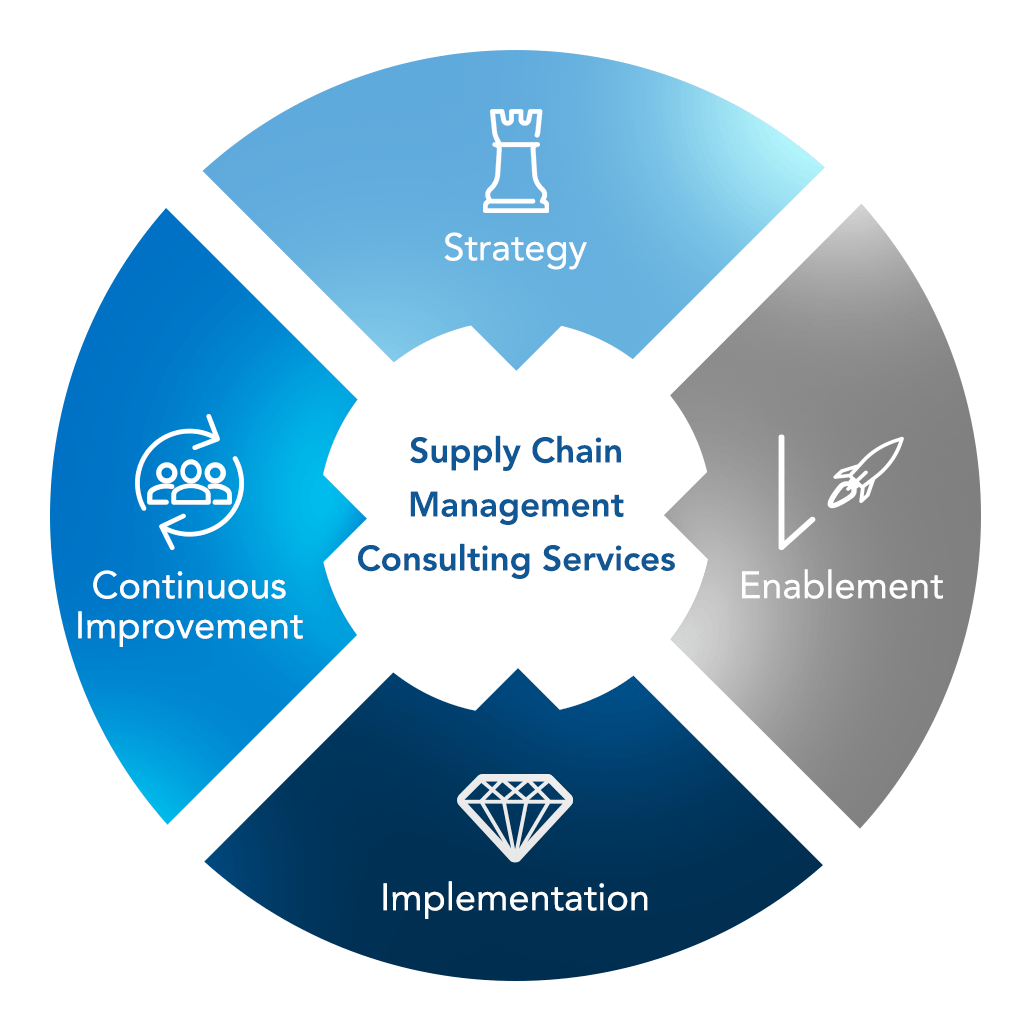
Our process: how a supply chain engagement works
Supply chain projects fail when analysis never becomes action — when the diagnostic report is impressive but nothing on the warehouse floor or the freight invoice actually changes. Our engagements are built the other way around: every phase exists to make the next one executable, and you can see exactly where we are at any point.
-
Analysis — weeks 1–4
We get into your data and onto your warehouse floor: shipment files, inventory records, order profiles, carrier invoices and process walk-throughs. The output is a fact base — your true cost per order, stock health, service performance and the gaps against benchmark — plus the levers ranked by value.
-
Strategy — weeks 5–6
We present a prioritised roadmap with a quantified business case for every recommendation: expected savings, required investment, payback time and risk. You decide what to pursue knowing exactly what each initiative is worth.
-
Implementation — months 2–6
We execute alongside your team: tenders run and contracts negotiated, stock policies loaded into your systems, layouts changed rack by rack, S&OP meetings installed and coached. Progress is tracked against the business case in a shared plan, week by week.
-
Follow-up — ongoing
We verify that savings actually land in the P&L, hand over dashboards and KPIs your team can run the operation by, and return for periodic reviews as volumes, carriers and markets shift.
Typical starting points: a supply chain cost scan (3–4 weeks) that quantifies your savings potential across freight, inventory and warehousing; a stand-alone freight tender project; or a full end-to-end supply chain transformation. We'll recommend the smallest engagement that solves your problem.

What you gain from working with us
Supply chain work pays for itself or it isn't worth doing. Our engagements are scoped so the value is measurable, and clients typically see:
- Lower freight and warehousing cost per order — negotiated rates, smarter flows and a warehouse that ships more with the same team.
- Less working capital tied up in stock — inventory sized to service targets, releasing cash you can invest in growth.
- Higher availability and on-time delivery — fewer stockouts on the products that drive your revenue, and a delivery promise you keep.
- Operations that scale — processes, layouts and carrier setups that absorb the next doubling of volume instead of breaking under it.
- Agreements with real market leverage — carrier and 3PL contracts benchmarked, tendered and structured in your favour.
- Data and KPIs to run the operation by — cost per order, stock health, service levels and forecast accuracy on one dashboard, so decisions stop being guesswork.
Just as important is what you keep after we leave: documented processes, trained people and a working KPI cockpit. Our goal is never to make ourselves indispensable — it is to leave behind an operation your own team can measure, manage and keep improving without us on the payroll.
We are honest about timelines. Freight savings can land within a quarter; inventory and network changes build over six to twelve months. You will always get a realistic forecast up front — and if we don't believe the business case is there, we will tell you before you spend a euro on consulting.
Why Bull Consult for logistics & supply chain?
Plenty of firms will analyse your supply chain. Here is what makes our consultants different:
- Operators, not just analysts. Our consultants have run warehouses, managed peak seasons and negotiated freight agreements for real operations. We know what breaks at 4pm on a Friday before Black Week — because we've been there.
- Quantified before recommended. Every recommendation comes with a business case: expected savings, investment, payback and risk. No initiative goes on the roadmap without a number attached.
- Hands-on implementation. We don't leave you with slideware. We are on the warehouse floor when layouts change and at the table when carrier tenders are negotiated — until the results are in your P&L.
- Vendor-independent. We take no commissions from 3PLs, carriers or system vendors. When we recommend a partner or a platform, it's because the numbers say so — not because of a referral fee.
- AI where it earns its keep. Through our AI & automation practice we bring machine-learning forecasting and warehouse automation expertise into supply chain projects — applied where it demonstrably improves accuracy or productivity, not for the buzzword.
Let's find the money hiding in your supply chain
The first step costs nothing: a 30-minute consultation where we look at your volumes, your cost structure and your biggest pain points, and tell you honestly where we see savings potential — and where we don't. Most companies are surprised by how much value sits in freight agreements and inventory alone; the scan that finds it takes weeks, not months.
Ready to ship faster, cheaper and with your cash working for you instead of sitting on a shelf?